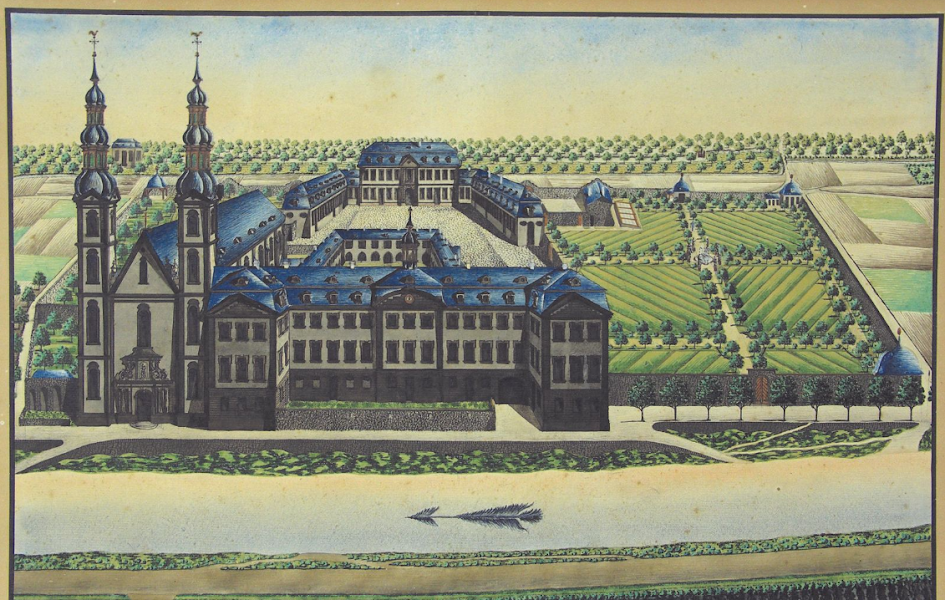
The Monastic Origins and 2,500-Year Chronicle of the Mergener Lineage
Etymology & Historical Thesis: The surname Mergener is a regional locative and occupational surname originating in Trier, Germany. It explicitly identifies the families, tenant farmers, viticulturists, and botanical stewards who lived, worked, and cultivated the agricultural estates and vineyards of the Benedictine Abbey of St. Mary of the Martyrs—known universally in the local Moselle-Franconian dialect as St. Mergen.
Core Hypothesis Summary
- Linguistic Derivation:
St. Maria ad Martyres→St. Mergen(Dialect) +-er(Locative/Occupational Suffix) = Mergener ("one belonging to or working the lands of St. Mergen"). - Monastic Engine: A political powerhouse within the Electorate of Trier (Kurtrier), St. Mergen managed prime vineyard terroirs (including the 1030 CE Luxembourg grant of the Scharzhofberg) and botanical test grounds.
- Occupational Roots: Monastery stewards cataloged soils, harvests, and grafting techniques in the Gardens of St. Mergen, generating an occupational identifier that crystallized into an enduring hereditary family name.
- Physical Anchors in Trier: The Mergener Hof (urban tithe court at Rindertanzstraße 4), Mergener Straße, and the Exhaus abbey remnant.
Structural & Physical Evidence in Trier
The Mergener Hof
Located at Rindertanzstraße 4 in Trier, this historic Pfleghof served as the secure urban estate court used by the abbey to collect, store, and manage agricultural tithes, wines, and estate assets.
Abbey Lands & Exhaus
Situated in Trier-Nord along the Moselle, Mergener Straße marks the historical precinct of the monastery grounds, anchoring the remaining abbey building, the Exhaus.
Chronicle of the Lineage: 500 BC – 1805 AD
Over 2,500 years ago, the Celtic-Germanic Treveri settled the Moselle Valley. Renowned for their formidable cavalry and river trade, they navigated the Moselle and Rhine to establish commercial networks floating timber, textiles, and agricultural goods, setting the foundational human footprint of the valley.
Following Roman conquest, the region became Augusta Treverorum (Trier), favored capital of Emperor Constantine the Great. Outside the northern city walls, early Christian sanctuaries took root above Roman catacombs—laying the physical foundation for the future abbey.
By the 7th century, the martyr chapel evolved into the Benedictine Abbey of St. Maria ad Martyres. In the regional Moselle-Franconian dialect, locals contracted the name to St. Mergen. Under Carolingian rule, the monastery functioned closely alongside the powerful Prince-Bishops of Trier.
In spring 882 AD, Viking raiders sailed up the Moselle, sacking Trier and burning riverbank monastic holdings. The local population rebuilt their stone estates and fortified their river sanctuaries, preserving the core settlements surrounding St. Mergen.
Functioning at the right hand of the Archbishop-Electors of Trier (Kurtrier), the abbey expanded its economic power. In 1030 CE, following the Moselfehde, the House of Luxembourg granted the abbey five Hufen of semi-baren land of slate hills at Wiltingen— and turned it into the the world-famous Scharzhofberg vineyard estate—establishing St. Mergen as a viticultural powerhouse.
Across the abbey's manors and the famous Gardens of St. Mergen, viticulture and horticulture were meticulously documented. Agricultural stewards, cellar master craftsmen, vineyard hands, and tenant farmers who tilled these soils were known throughout the valley as the Mergener. Over generations, this occupational and territorial identifier transformed into a hereditary family name.
French Revolutionary troops occupied Trier in 1794. Under Napoleon Bonaparte's secularization decrees of 1802, the 1,000-year-old Abbey of St. Mergen was dissolved. Its estates were auctioned off between 1801 and 1804. Families bearing the Mergener name transitioned from monastic tenant stewards into independent landowning citizens in villages like Wasserliesch, Wiltingen, and Konz.
However, most never recieved much if anything and were encouraged and persuaded by private colonization companies to emigrate abroad. Passage could be bought to America and the Emperor of Brazil Dom Pedro II offered "free passage and land" in an effort to to form a "human shield" buffer zone, populating the frontiers with loyal, land-owning farming families.Archival Holdings & Academic Literature
Primary Record Groups
- Landeshauptarchiv Koblenz (Bestand 218 / 207): Abtei St. Maria ad Martyres (St. Mergen) vor Trier. Central administrative holdings, land charters, tenant rosters, and court registers (Vogteigerichtsakten).
- Landeshauptarchiv Koblenz (Abt. 702, Nr. 128 / Biens Nationaux): Public auction registers (1798–1804) recording the French secularization and sale of St. Mergen's vineyard estates.
- Stadtarchiv Trier: Parish registers (Kirchenbücher) of Konz, Wasserliesch, and St. Valerius documenting the transition of Mergener families to private landowners.
Key Secondary Sources & Citations
Bärsch, G. (1839). Der Moselstrom von Metz bis Coblenz: Ein historisch-topographisches Handbuch. Trier: Troschel Verlag.
Jung, C. (1936). Die Säcularisation der Klöster im Departement der Saar (1798–1814). Trierer Zeitschrift für Geschichte und Kunst des Trierer Landes, 11, 45–89.
Jungandreas, W. (1964). Historisches Ortsnamenbuch des Landes Rheinland-Pfalz. Mainz: Akademie der Wissenschaften und der Literatur.
Kentenich, G. (1915). Geschichte der Stadt Trier von ihrer Gründung bis zur Gegenwart. Trier: Lintz.